
Executive answer
TELUS Health MyCare’s Alberta page helps people decide whether to book an online doctor visit.
The problem: The page lists specialist referrals under “We can help you with,” lists only medical emergencies under “We can’t help with,” and then tells the visitor to download the app and register. Its later FAQ says a referral may require an in-person assessment or the person’s primary-care provider. At the point of action, the page does not distinguish a service a clinician can start or assess from an outcome the virtual visit can complete.
The recommendation: Replace the two-state “can/can’t help” list with three states before the download step: “Can often start here,” “May require another provider or in-person step,” and “Use emergency services now.” Put the referral qualification beside “Specialist referrals,” not several sections later.
The decision consequence: If a virtual-care team optimizes the path to download and booking before setting an accurate scope expectation, it may move uncertainty deeper into the care journey instead of resolving it.
Independent public-material review. Violet reviewed the publicly accessible Alberta version of the TELUS Health MyCare doctors page on August 8, 2026. Violet was not commissioned by, and is not affiliated with, TELUS Health. We did not inspect the app, observe consultations, review private analytics or assess clinical quality or patient outcomes. The public sequence is documented below; the diagnosis and redesign are hypotheses to test.
The proposal at a glance
The recommendation is easier to assess as an interface than as three bullets. The concept below moves service-scope guidance ahead of the download action without attempting to predict an individual clinical outcome.
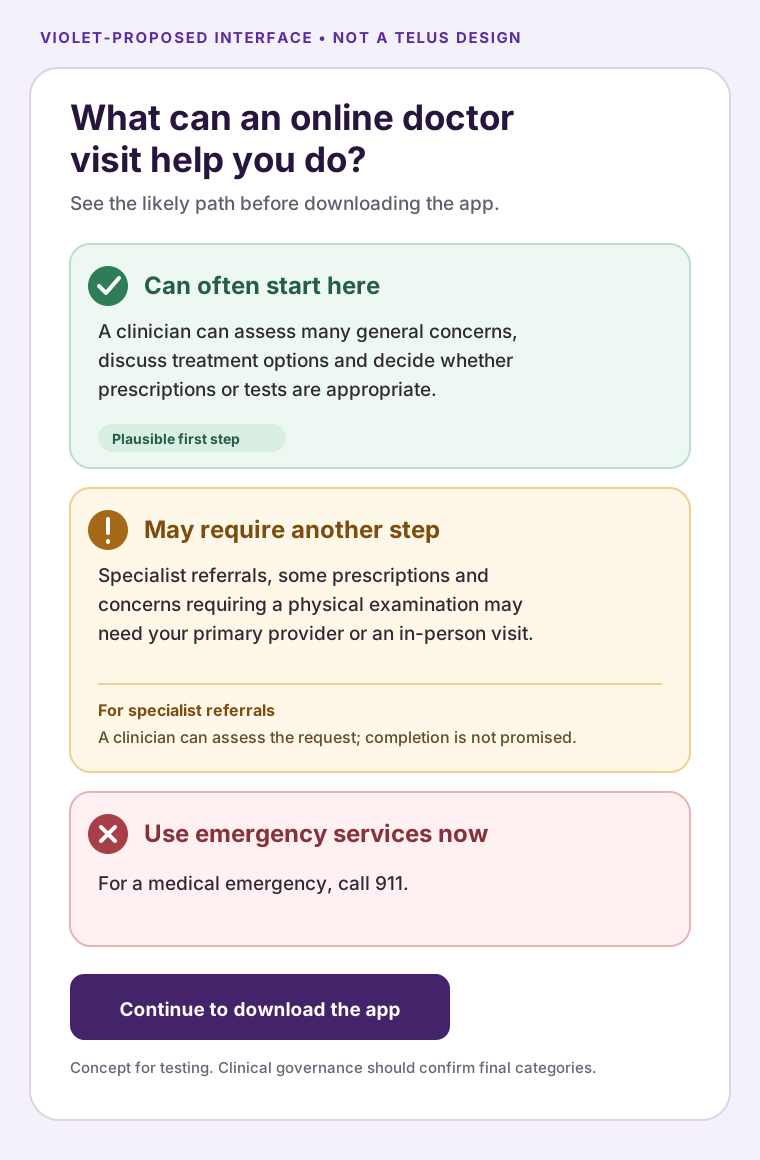
To judge whether that added qualification earns its place, start with the sequence visitors currently see.
The public path we reviewed
The page begins with a direct promise: see a doctor online “at no cost to you,” subject to a provincial-coverage footnote. It then describes choosing a doctor, booking a convenient time and receiving prescriptions.
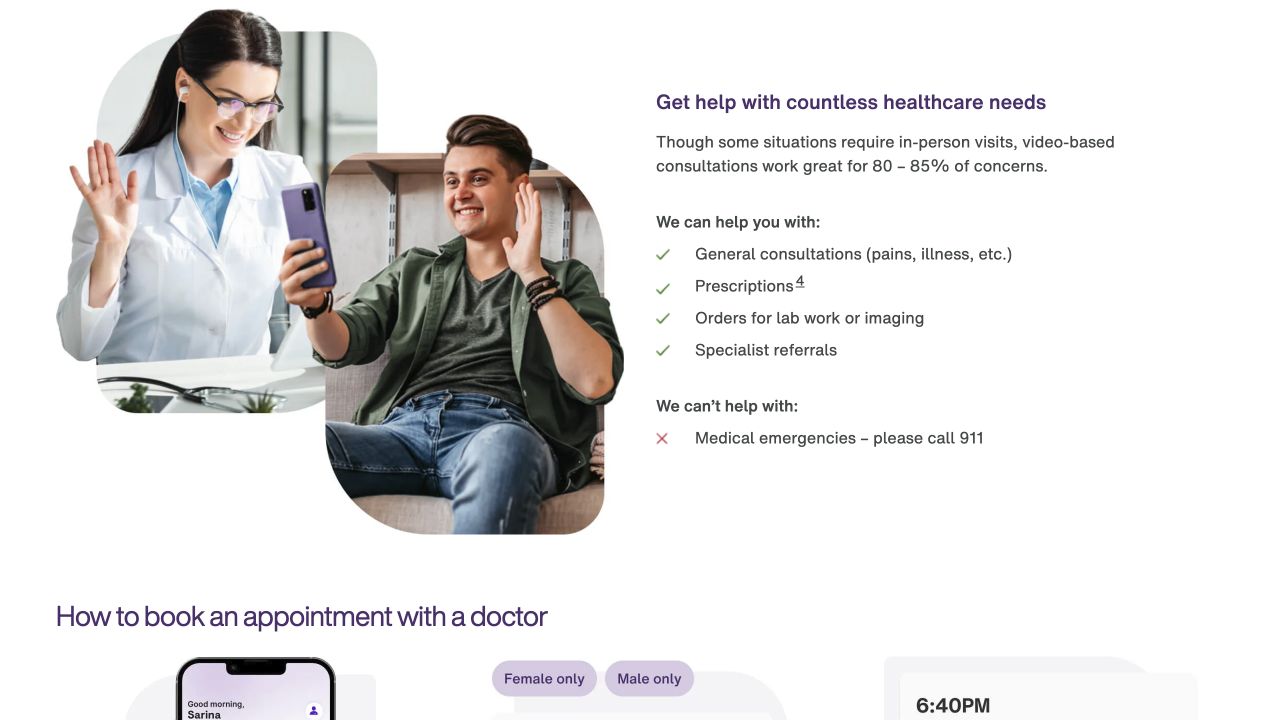
The service-scope section says video consultations work for “80–85% of concerns.” Under “We can help you with,” it lists:
- general consultations;
- prescriptions;
- lab or imaging orders; and
- specialist referrals.
Under “We can’t help with,” it lists one category: medical emergencies, with an instruction to call 911. (TELUS Health MyCare doctors page)
The next section is “How to book an appointment with a doctor.” Step 1 is to download the MyCare app and register for a free account. Step 2 is to choose a doctor. Step 3 is to schedule the video appointment.
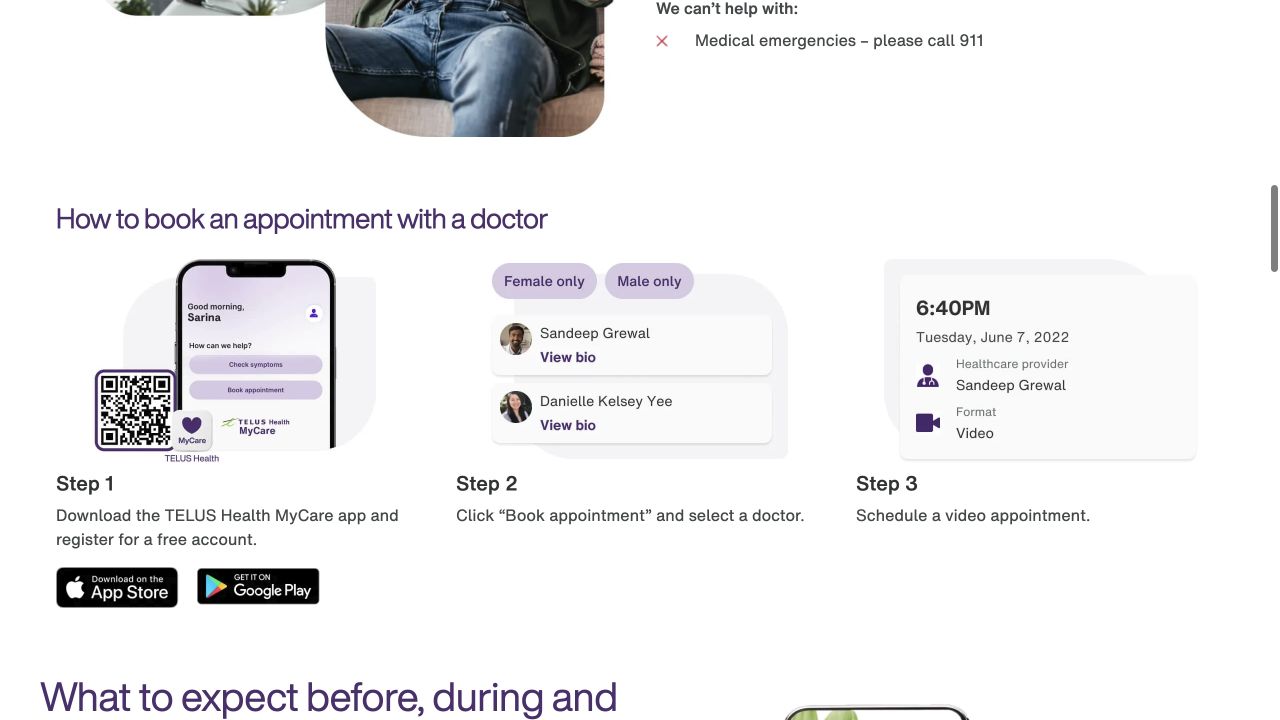
That is a clean three-step booking path. The missing step is deciding what the booking is likely to accomplish.
The important qualification appears later
Near the bottom of the page, the FAQ gives a more conditional account of specialist referrals. It says patients attached to one of the clinics may be referred by their primary-care provider and may need an in-person visit first. For other patients, a clinician may be able to help arrange a referral after deciding whether it fits the service’s scope.
Another answer says a person’s primary-care provider is usually their best resource and that specialist referrals can be complex enough to require an in-person assessment. The prescription footnote also explains that some medications require an in-person assessment and an established clinical relationship. (TELUS Health MyCare FAQ and terms)
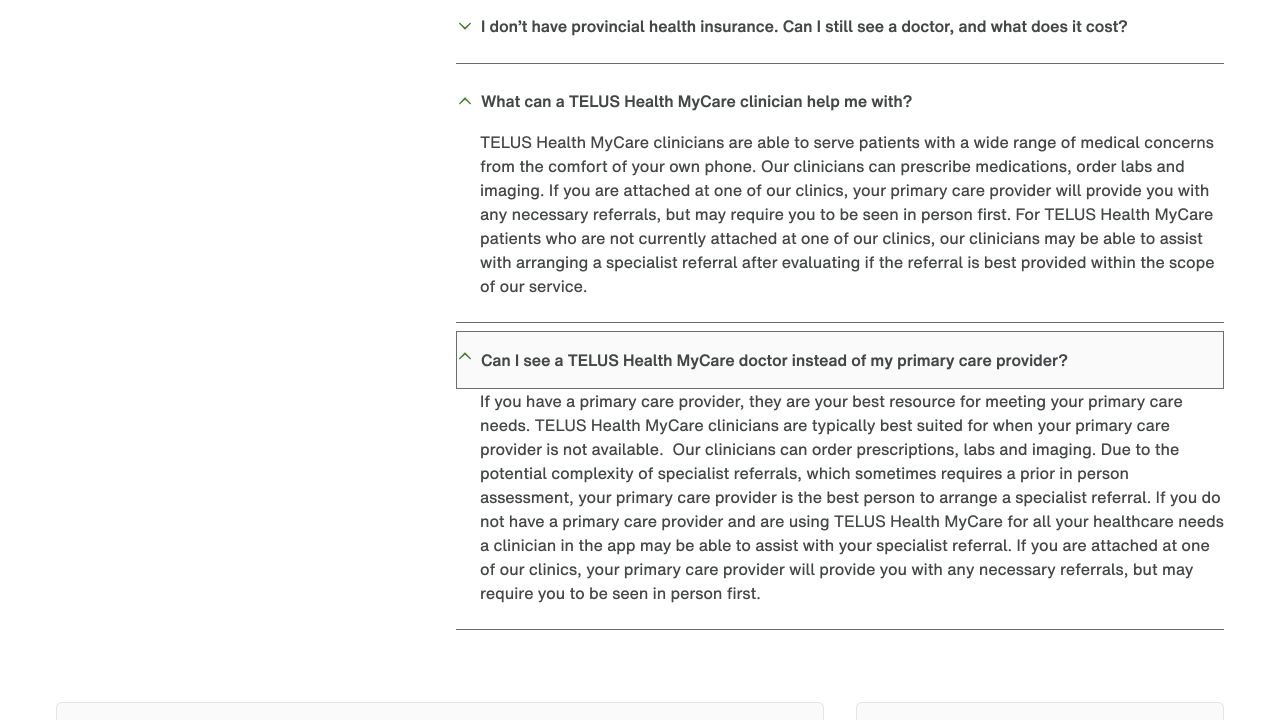
The page therefore contains the responsible qualification. The issue is not its absence. It is the sequence in which the visitor receives it.
“Can help” is not one outcome
“Can help with a specialist referral” can mean several legitimate things:
- a clinician can discuss the request;
- a clinician can assess whether a referral is appropriate;
- the virtual service can initiate the referral;
- another provider or an in-person examination is required first; or
- the concern should take a different route entirely.
The public list compresses those possible states into one green check mark. The later FAQ unpacks them, but only after the page has already made downloading the app the obvious next action.
That distinction matters because appropriateness is not a fixed property of “virtual care.” Alberta’s medical regulator requires an appropriate assessment before treatment or referral and says clinicians must consider the presenting concern, the need for a physical examination and the ability to arrange one. (College of Physicians & Surgeons of Alberta virtual-care standard) Health Canada’s policy framework similarly describes virtual care as an additional channel that should complement face-to-face care and emphasizes appropriateness, safety and quality. (Health Canada virtual-care policy framework)
The page does not need to predict a clinical decision. It needs to show which decision still remains.
Put a three-state scope guide before download
Violet would test a replacement for the current two-state block:
- Can often start here. “A clinician can assess many general concerns, discuss treatment options and decide whether prescriptions or tests are appropriate.” This makes a virtual visit a plausible first step without promising completion.
- May require another step. “Specialist referrals, some prescriptions and concerns requiring a physical examination may need your primary provider or an in-person visit.” This makes the possible handoff visible before booking.
- Use emergency services now. “For a medical emergency, call 911.” This keeps urgent care outside the booking path.
The specialist-referral line could become:
Specialist referrals: A MyCare clinician can assess your request. Depending on your concern and care history, you may need an in-person assessment or your primary-care provider to arrange the referral.
Then keep the existing app-download path.
This is smaller than building a symptom checker. It asks for no health information, does not attempt diagnosis and leaves clinical judgment with the clinician. It simply separates starting a care task from finishing it in one channel.
The responsible counterargument
The current page has real strengths. It names emergencies clearly, includes coverage and prescribing footnotes, describes what happens during a visit and provides the referral qualification in its FAQ. A clinician cannot know whether a virtual assessment is sufficient before hearing from the patient. A highly qualified scope block could also become so cautious that it discourages people for whom virtual care would be useful.
Those are reasons to test the change, not to turn the page into a catalogue of warnings.
The strongest rival explanation is that visitors understand “can help” as “can assess,” use the FAQ when needed and arrive at consultations with appropriately calibrated expectations. If that is true, moving more qualification upward may add Strain without improving the next decision.
What to measure
Compare the current block with the three-state version. Measure:
- correct answers to “Can this service always complete a specialist referral virtually?”;
- movement from the scope block to app download and completed booking;
- consultations that require an unexpected in-person or primary-provider handoff;
- time from page entry to the appropriate care channel;
- support questions about referrals, prescriptions and in-person requirements;
- whether the added qualification disproportionately deters people who could use virtual care; and
- urgent-care comprehension as a non-negotiable safety guardrail.
Do not use fewer downloads as proof of failure or more bookings as proof of better care. The target transition is an informed next step, not a click.
What would prove Violet wrong?
The hypothesis would weaken if visitors exposed to the current page already predict the referral and in-person boundaries as accurately as visitors shown the redesigned block.
It would also weaken if the three-state version causes people to interpret “may require another step” as “virtual care cannot help,” reduces appropriate access, or performs no better than a shorter link to the existing FAQ. Those results would favour the current design or a lighter intervention.
The decision behind the page
A healthcare service page is not only describing what the organization offers. It is helping someone choose a channel of care.
That choice becomes easier when the page separates three questions: Can I start here? Can this likely finish here? What happens if it cannot?
This is the broader journey-design problem explored in Digital Health Engagement Is a Journey Design Problem. For a virtual-care, patient-portal or care-navigation journey, Violet can review the visible path, locate the first unsupported transition and design a bounded test. Discuss a digital-health journey.